Business · EU Weekly
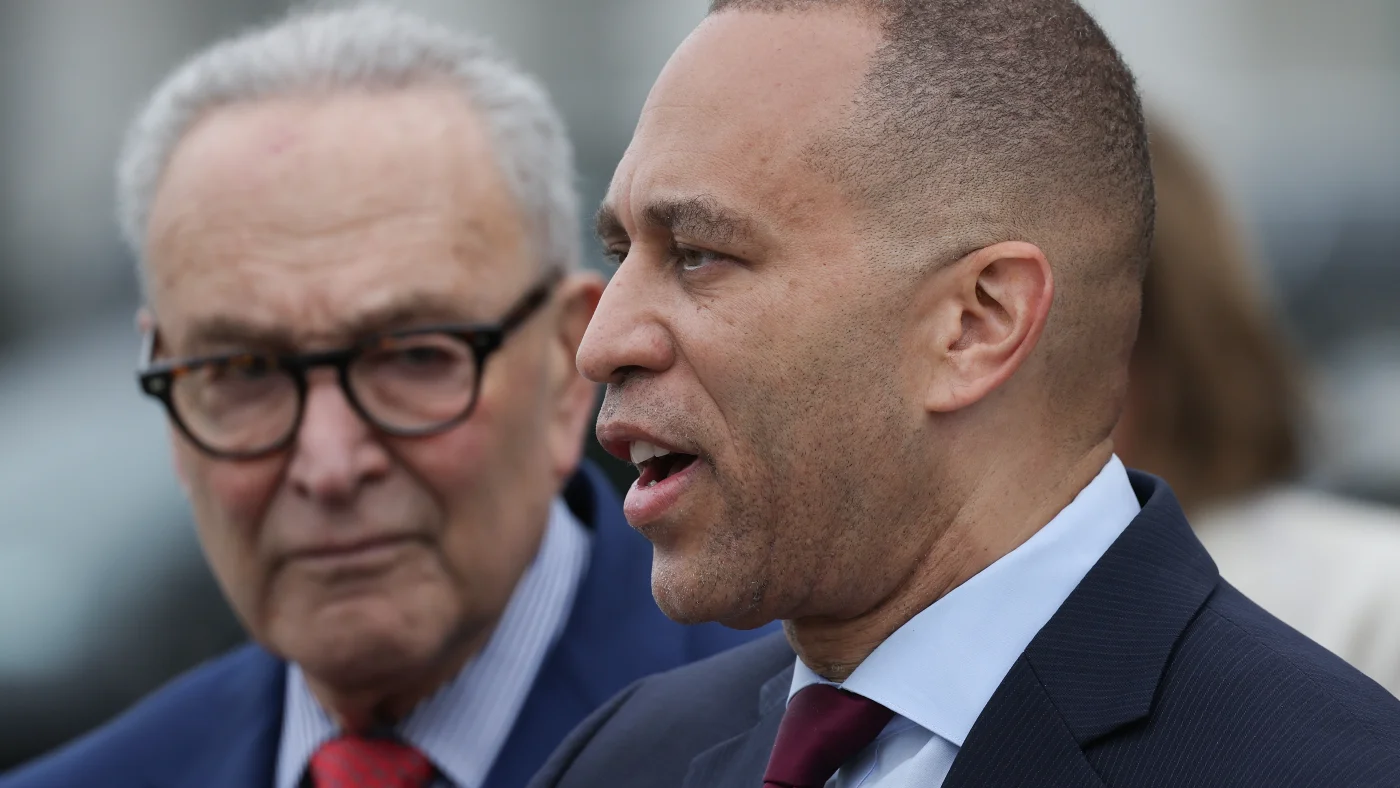
House Democratic Leader Hakeem Jeffries, D-N.Y., and Senate Democratic Leader Chuck Schumer, D-N.Y., are seen here on the steps of the U.S. Capitol on May 21, 2026. The pair of Democratic leaders have acknowledged the public wants them to act quickly on issues of affordability with their newfound majority come January.
Win McNamee/Getty Images hide caption Win McNamee/Getty Images After a sweeping set of midterm victories, Congressional Democratic leaders say they're clear-eyed about their mandate come January. "We're going to fight to make sure that we make this country affordable for every single American," said Democratic Leader Hakeem Jeffries, who is the presumptive House speaker , on Tuesday night. "This is a change election, and we understand as House Democrats we need to deliver dramatic change." Speaking to reporters on Wednesday, Senate Minority Leader Chuck Schumer, D-N.Y., added "relief is on the way" but acknowledged some of the public may be skeptical that Democrats can deliver on the economic message that catapulted them to recapturing both chambers of Congress.
Democrats will control the legislative branch, but won't have a large enough majority to overturn a presidential veto and will likely face Republican filibusters in the Senate. "That doesn't mean that nothing can happen, but it means there are real obstacles," said Bobby Kogan, senior director of federal budget policy at the Center for American Progress, a left-leaning think tank based in Washington, D.C. Matt Bennett of Third Way, a center-left think tank, said those obstacles create the potential for voters to be disappointed by the limitations inherent in divided government.
"What Democrats were really promising was: return us to power, we will put a check on Trump for two years, and then when we get the White House in 2028, we can actually make your lives better. It isn't clear to me that voters heard the entire message," Bennett said. "They might have just heard the last part, and so there is some risk that voters will be disappointed." The power of playing offense An important power that comes with being in the majority is controlling which bills make it to the floor for a vote.
"There will be plenty of bills where the purpose is contrast — Democrats are for this and Republicans are against that," Kogan said. "But what is special about controlling both chambers is that legislation where the public is on [Democrats'] side and it's very difficult for Republicans to argue why they're against it, those sorts of things become real." As an example, he points to the release of the Epstein files. President Trump and Republican leadership worked to prevent the measure from reaching the floor last year.
Once it was brought to a vote in the House via a legislative end run around Speaker Mike Johnson, lawmakers were forced to go on the record and voted nearly unanimously to release the files. "The difficulty was just getting it there," Kogan said. "And what Democrats can do is they can make popular things get there." Forcing votes on popular issues has been a winning strategy in previous divided governments.
After Democrats won control of Congress in the 2006 midterm elections, they made raising the minimum wage a signature issue, and Republican President George W. Bush went on to sign it into law. Democrats have signaled plans to put forth bills to help Americans with health care costs, bring back enhanced premium tax credits, and undo Medicaid cuts.
"I think that's going to be critically important — that when you vote for a Democrat, your life improves," said Rebecca Cooke, the Wisconsin Democrat who unseated GOP incumbent Derrick Van Orden in the state's 3rd congressional district. Democrats also have the ability to use budget reconciliation , a tool that bypasses the threat of a Senate filibuster by allowing certain budget-related bills to pass with a simple majority. Democrats used reconciliation to pass some health care changes in 2010.
Republicans used it to pass tax cuts in 2017 , and it was used to pass Trump's signature tax and spending bill. Massachusetts Sen. Elizabeth Warren is already calling on her party to embrace reconciliation, writing in Time this week that Democrats should use it to "reverse Republican health care cuts, expand health care coverage, and fund universal child care." Embrace the veto Trump has sent mixed signals about what kind of leader he'll be in divided government, saying he'll "veto everything" and that he could "make deals" with Democrats.
Congressional Democrats are already pushing back at the idea that a veto is a deterrent. "If we have a bill that is bipartisan to restore healthcare for the people who lost their Medicaid or to improve access to affordable medicines and other things, like, I dare him to veto that," Sen. Kirsten Gillibrand told Morning Edition .
"If he decides to veto the common sense things that get groceries down or housing prices down, then '28's going to be very favorable for Democrats." Embracing the veto – rather than running away from it – can be an effective political tool. "You might see legislation that is meant to address the effects of the tariffs that Democrats could pass, then dare President Trump to veto and use that as a mechanism for signaling to the American people where Democrats are versus where the president is," said Molly Reynolds, a Congress expert at Brookings. Lindsay Owens, president of the think tank Groundwork Collaborative, adds voters want to see action.
A hat reading "VETO" sits on the Resolute Desk as President Trump speaks in the Oval Office on Nov. 5, 2026. Mandel Ngan/AFP via Getty Images hide caption Mandel Ngan/AFP via Getty Images "I don't think the American people sent this many Democrats to Congress to hear a bunch of talk about what they can't do. That will go over like a lead balloon," Owens said.
"Democrats need to send those bills to the president's desk. If he vetoes them, that news cycle will be good for Democrats – like, 'Trump vetoes bill that would have lowered your health care cost.'" Bennett, of Third Way, said delivering legislation fast will help Democrats long-term. "They need to be caught trying, as Bill Clinton would say.
And then they can turn to voters and say, look, this is what we would do for you if it wasn't being blocked by Republicans," he said. Rep. Brad Schneider, D-Ill., said in divided government, it's important to make sure voters know exactly what Democrats are trying to do — to ward off any disappointment that priorities face GOP roadblocks.
"We have to constantly communicate where we are," said Schneider, who chairs the New Dems coalition. "Make sure people understand what we're doing, when, and why." What about the war and gas prices? A man walks past posters highlighting high food and gas prices and urging people to vote in Dallas, Texas, on Nov. 2, 2026.
Ricardo Arduengo/AFP via Getty Images hide caption Ricardo Arduengo/AFP via Getty Images A change in legislative power won't bring down fuel costs anytime soon. Lawmakers don't have a direct path toward lowering the price of oil, which is shaped by a complex global market . Democrats plan to reassert the legislative branch's authority over tariffs and bring new votes on a war powers resolution, to force an end to the Iran war, which has raised the price of fuel.
"We can advance strong war powers resolution that the president will have to take up. Get it to his desk and then explain himself to the American people if in fact he decides to use his veto pen," Jeffries said in an interview Friday with Morning Edition . But the war powers resolution has largely been ignored by presidents of both parties, with administrations sidestepping its requirements.
An alternative option for Democrats to address the war is through appropriations bills that fund the government, with a provision that prohibits funds from being used to carry out military operations in Iran. Sam Gringlas contributed reporting
Source: NPR